Integrated Waste Management in Sri Lanka: From Community Action to Scalable Infrastructure Solutions
In response to growing environmental challenges, the Federation of Film and Media Cultural Exchange (FFMCE) continues to lead impactful initiatives in sustainable waste management, combining community engagement, technology adoption, and strategic planning.
This article highlights key insights from recent fieldwork, technical frameworks, and practical solutions designed to transform waste into valuable resources.
Understanding the Waste Challenge
Waste management is no longer just a municipal responsibility—it is a critical environmental, economic, and social issue. Poor waste handling leads to:
- Environmental degradation
- Public health risks
- Loss of valuable recyclable materials
- Marine pollution, especially in coastal regions
In coastal regions, waste rapidly flows from streets into drainage systems and reaches the ocean, causing serious damage to tourism and fisheries industries.
Beruwala Integrated Waste Management Seminar
🌱 A Successful Step Towards Sustainable Waste Management! ♻️
FFMCE successfully conducted the Integrated Waste Management & Recycling Seminar at ZIMICH, Beruwala. This inspiring session focused on sustainable waste solutions and resource circulation.
Participants gained valuable knowledge on:
- Global waste management trends
- Korea’s advanced recycling systems
- Innovative small-scale waste incineration technologies
The seminar brought together experts, organizers, and partners to drive environmental responsibility and innovation in Sri Lanka.
See more: FFMCE FaceBook
Field Implementation: Polgahawela Waste Management Initiative
As part of its ongoing sustainability mission, FFMCE collaborated with the Polgahawela Pradeshiya Sabha to:
- Raise awareness on effective waste management
- Observe and analyze local waste characteristics
- Identify practical and scalable long-term solutions
Key Outcome: Waste to Agriculture
One of the most impactful outcomes of this initiative was the introduction of:
- Organic compost
- Liquid fertilizer
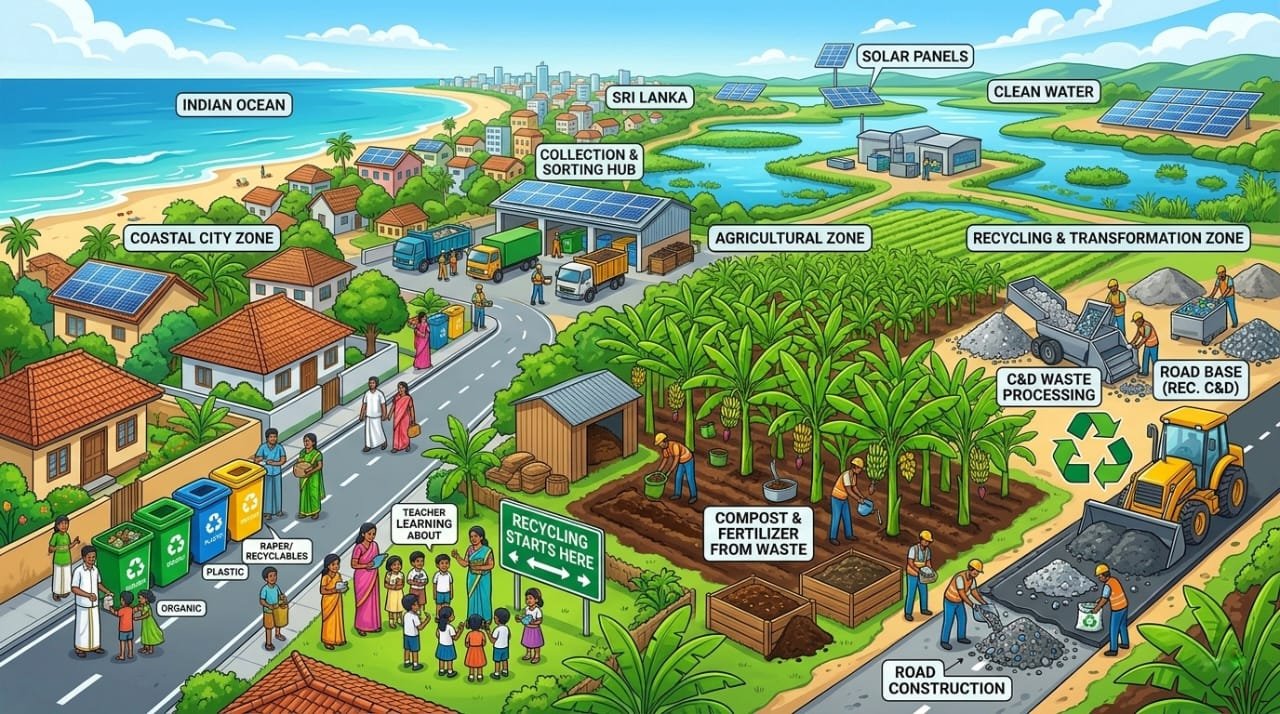
These sustainable by-products are now being utilized to support banana cultivation in the Polgahawela region, demonstrating a powerful circular economy model where waste is transformed into agricultural value.
The Plastic Protocol: Three Steps and One Rule
Efficient plastic recycling starts at the source through a simple but effective system:
- Step 1: Empty – Remove all food and liquid waste
- Step 2: Clean – Wash plastics to remove oils and dirt
- Step 3: Dry – Ensure materials are dry to maintain quality
The Absolute Rule: DO NOT MIX. Mixed waste disrupts recycling systems and often leads to landfill disposal.
Why Organic Waste Separation is Non-Negotiable
Unseparated food waste is the root cause of multiple waste management failures:
- Public Hygiene Collapse: Causes odors, attracts pests, and spreads disease
- Cross-Contamination: Ruins recyclable materials such as paper and plastic
- Incineration Failure: High moisture content reduces efficiency and increases emissions
Key Insight: Separating organic waste is the fastest and most effective way to improve urban cleanliness and optimize all downstream waste technologies.
Feedstock Integrity: The In/Out Mandate
Modern waste systems must follow a strict principle:
Thermal treatment (incineration) is exclusively for non-recyclable residual waste.
Approved (IN):
- Non-recyclable residual materials
- Mixed or contaminated waste
Prohibited (OUT):
- Organic waste (must be composted)
- Recyclables such as plastics, paper, and metals
- Hazardous waste like batteries and electronics
The goal is clear: Manage the unmanageable without damaging the recycling ecosystem.
C&D Waste: From Debris to Infrastructure
Construction and demolition (C&D) waste can be transformed into valuable infrastructure materials through:
- Crushing and screening concrete and bricks
- Extracting metals and reusable resources
- Producing aggregates for construction
These processed materials are used in road foundations and infrastructure development, reducing landfill pressure and conserving natural resources.
Strategic De-Risking: The Pilot Approach
Large-scale waste management projects often face challenges such as:
- High capital investment requirements
- Land acquisition constraints
- Public resistance
To overcome these, FFMCE promotes a small-scale pilot model (around 3 tons per day capacity) to validate:
- Operational safety
- Environmental compliance
- Social acceptance
Key Principle: Decisions must be driven by real operational data, not theoretical assumptions.
The Unique Vulnerability of Coastal Cities
Coastal regions face accelerated waste leakage due to:
- Rapid movement from streets to drainage systems
- Direct discharge into rivers and oceans
Economic Impact:
- Tourism: Polluted beaches reduce visitor attraction
- Fishing: Marine plastic disrupts ecosystems and livelihoods
Conclusion: Waste separation in coastal cities is not just environmental protection—it is economic defense.
Moving Toward a Circular Waste Economy
FFMCE’s integrated strategy focuses on:
- Waste reduction at the source
- Resource recovery and reuse
- Community awareness and participation
- Scalable and sustainable infrastructure solutions
By combining education, innovation, and partnerships, we are building a future where waste is no longer a problem—but a resource.
About FFMCE
Federation of Film and Media Cultural Exchange (FFMCE) is a global initiative committed to sustainability, innovation, and community-driven development through international collaboration.
Website: www.ffmce.com
Linked in Community: FFMCE Linked in
FaceBook Community: FFMCE FaceBook
Contact UsSpecial Thanks
We extend our heartfelt gratitude to the following individuals and organizations for their invaluable contributions in making this project a success:
FFMCE Co-Founder- Ravindra Gayanath – For the complete coordination of this event and for fostering bilateral governmental and technical cooperation, bringing this significant project to Sri Lanka. (This project is by Ravindra Gayanath.)
- Mr. Youngsu Lee – CEO, Mirae Nanotech Co., Ltd
- Kang Taeseok – Chairman, Mirae Nanotech Co., Ltd
- Mr. Dongsun Choi – President, Hanyong Education Foundation
- Prof. Donghoon Yoon – Keimyung University
- Mr. M.A.M. Mabazim – Mayor, Beruwala Urban Council
- Mr. Wimalasiri Silva – Deputy Mayor, Beruwala Urban Council
Keywords: Waste management Sri Lanka, recycling solutions, organic compost Sri Lanka, plastic waste management, coastal pollution, circular economy, waste to energy, sustainable agriculture, C&D waste recycling, environmental sustainability